• Home
  • About
  • Narration
  • Content
  • Creative Writing
  • Food & Travel
  • Photo
Menu

that Bob Jones

  • Home
  • About
  • Narration
  • Content
  • Creative Writing
  • Food & Travel
  • Photo

Photo © Rob Jones

Indoors If Wet

June 23, 2026

So … we live in a wet country. Some parts are wetter than others.

Rain is seldom a shock.

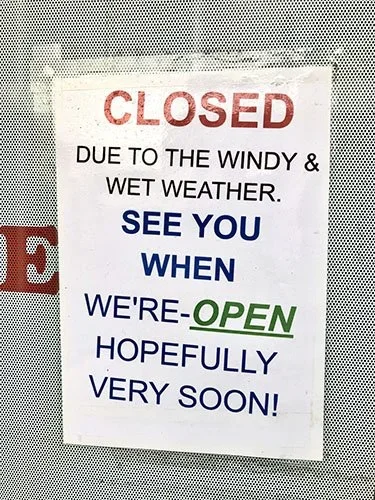
I had to wonder then, what has become of us as a nation to find large parts of Newquay closed because of the weather.

In its defence - there was a major storm coming in and the weatherman on the tele suggested people tie down their garden tranpolines. Serious stuff.

But it was still only on the shoulders (just) of the peak holiday season, and as far as I could see there were plenty of tourists repeatedly walking up and down the main road desperately looking for something to do.

Where is our fortitude?

When I were a lad (yes, I know I have become old without noticing) you would sit on the beach with a picnic at the height of a hurricane or monsoon. An ice cream in a torrential storm was a necessity. You would hike half way to Land’s End, just to look at a raging sea, a precipitous cliff and some damp Chuffs (Cornwall’s national bird.)

I know that in many ways, holidays are not to be enjoyed - but endured. They are proof positive that you are better off at work and at home. The best part being of course a slightly longer sleep in bed, being awoken only by the sound of someone trying your hotel room handle because they are too drunk to remember where their own room is, and the obligation to have a full English breakfast, followed by an overindulgence induced sense of regret.

This was my first time in Newquay, even though I had spent two years of my life in Cornwall. I liked it for its fabulous beaches, surfer vibe, trendy coffee shops and the apparent lack of shops selling wooden seagulls on sticks.

I was taken aback by the number of closed up and derelict hotels, gradually being replaced by cliff top luxury apartments which will end up as short term holiday lets.

And I just think it’s wrong to walk through the streets barefoot in a Dryrobe.

Would I go again?

Of course.

RJ

In Food Travel Headlines

Cabin Fever

June 23, 2026

It is family lore that my grandfather was a cabin boy.

But I don’t know when, and I don’t know where. But I imagine it’s where I get my wander-lust, itchy-feet from. (They are currently itchy.)

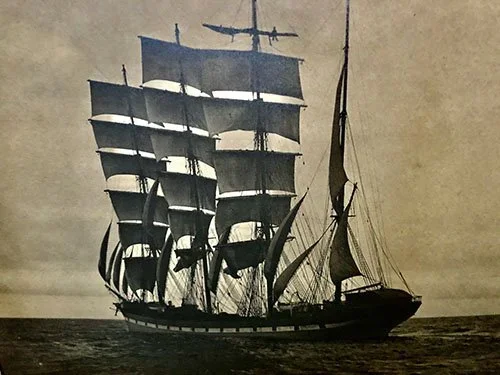
I do have hand-me-down memories - I was told as a child that he sailed round the Capes of Good Hope and Cape Horn. I have two photographs of sailing ships - see above - I have his sea chest (which was apparently repurposed as a cot for my uncle in 1923, and is now my linen chest), and my grandmother once told me of his wish to live in a little cottage just outside Caernarfon on the Menai Straits so that he could watch the boats go by. This never happened.

Travelling was clearly in the blood.

The other day, I stumbled across an account of a voyage from Caernarfon to America in 1818, when a lot of people left these shores to find a better, less complicated life. Not completely sure they found it, but the pull factor of the New World seems to have been so great that they would suffer the indignities of a long voyage into the unknown, possibly never to return.

But what was that voyage actually like?

The 1818 account tells the story of the Brig Albion and its master Llewelyn Davies. He had been hired by a man called Griffith Jones in Liverpool, with an all Welsh crew recruited in Cardigan. The plan was take a full load of passengers, men, women and childfren across the Atlantic on a voyage that would take 45 days in total. (Never will I complain about delayed European flights again.)

The ship left Caernarfon on the 21st of May, loaded with coal, food and water for a pessimistic three months

There was some feverish initial organisation. Four young men who tasked with lighting fires and acting as stewards. Seven men, heads of the families on board, were to act as a liaison group.

There were rules:

  • To keep the Sabbath, and attend services on deck - unless it was raining.

  • No swearing - punishable by a half ration of water and having to wear a badge (I like this concept.)

  • No stealing - Thief’s badge.

  • No lying - Punishment of cleaning the toilets.

  • No quarelling, creating doom and despondency (Important - but a tough ask for us Welsh).

  • Keep yourself clean - Or lose a half ration of water (seems counter intuitive.)

  • Don’t talk to the driver while the ship is in motion (the captain.)

  • Don’t allow children to run riot - or be last in the queue for food.

 All seems reasonable to me, and worth considering generally in life today.

Additionally:

  • Only the heads of the family could go into the store cupboards.

  • Chamber pots had to be emptied before dawn.

 Again, wise.

Foodwise - each passenger was allowed a ration of 7 pounds of food a week, consisting of preserved foods like salted beef, ship’s biscuit, vheese, dried beans, occasional fish if they could catch it, weevily biscuits, flour, rice, molasses and pickled vegetables. Water tended to go rancid so alcohol was preferred.

Was there anything on the journey to write home about?

Well, actually yes, just a tad.

Seven days into the voyage, there was a great amount of sea-sickness. The captain noted that many had their heads down, and were full of sorrow, hanging over the side. This was joined by widespread constipation.

The weather turned rough on the 3rd of June, and there was a lot more constitpation.

They spotted icebergs on the 11th of June. Many of the passengers got the trots.

17th of June, people cheered up generally when they spotted America for the first time.

18th of June - bed bugs discovered in some blankets. No one owned up. Some thought they saw pirates.

19th June - a fight broke out between two women because one’s wet clothing was dripping onto the other’s. It led to a punch up. Punishment - swabbing the decks for three days. Food was late because the cook’s cabin boy had put too big a pan on the stove and it was slow in heating up.

20th June - Man placed in coal hole for three hours for chucking stones at another passenger. 

As they neared New York there was much discussion about what would happen next. The best clothes were unpacked. A barrel of salty water was set up for the ladies to bathe in, and then men were sent below decks. The captain issued a warning not to eat too much Maple sugar on arrival because it would cause worms. Thoughts turned to onward journeys.

 27th June - an outbreak of lice among the children.

7th July - The Captain inspects his cargo (the passengers) before US immigration stepped aboard and gave approval to go ashore.

Initial observations - They were warmly welcomed by the Welsh community in New York. But that the Irish had a reputation for fighting all the time.

Then they all simply melted away into new lives in America, with many heading straight off to promised land around the Great Lakes.

(Source: Maritime Wales)

In Travel, Food Travel Headlines

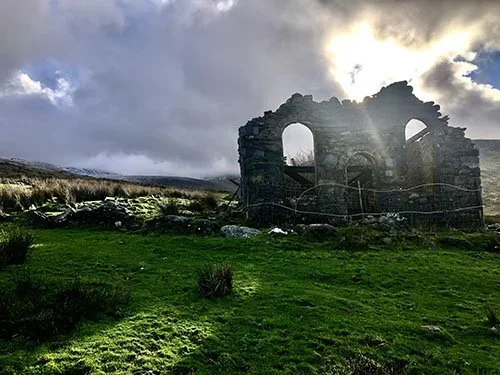
Hebron Chapel Remains - December 2025 - Photo © Rob Jones

Losing Faith

June 23, 2026

It’s a case of ‘blink and you’ll miss it.’

Unless you’re on foot, and you’ve lost your way.

For years now I’ve been watching the slow decay of Hebron Chapel on Snowdon. It’s a regular stop walking the dogs. To check it’s still there. To see what’s been lost to the elements and the thieves since my last visit. And yet to find that it’s still beautiful, no matter what happens to it.

One day it will be gone completely.

If you’re climbing Snowdon/Yr Wyddfa via the Llanberis path, and miss the sign, you’ll follow the road under the railway and find yourself with one of the best views of Wales’ highest mountain you can get. And there, to the right, just a few yards off the path is Hebron Chapel. Standing alone in a field overlooking the seemingly uninhabited valley of Cwm Brwynog.

That wasn’t always the case though. It was built in 1833 by Calvinist Methodists and could sit 120 people. At the time it was the valley’s only communal building and acted as a meeting house, concert venue and of course for religious services.

People have been living and farming here since medieval times at least. The valley thrived due to copper mining, the workings like sewing stitches up the nearby slopes.

The railway came in Victorian times. There was a family living in Hebron station, a hundred yards or so up the hill, who lived there rent free so long as they operated the points for the trains in the tourist season.

With the growth of the slate quarries, many families moved down into Llanberis village, and the the chapel eventually closed in 1958. The last service was held outside because they’d mislaid the key. There’s a photo of that event on Historypoints.org.

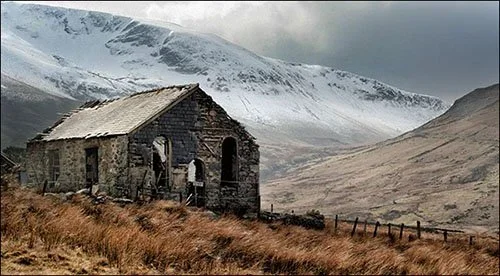
Hebron Chapel - 2013 - Photo © Rob Jones

When I first photographed it, in 2013, it still had a roof - just. But that was plundered some years back.

The rest, it seems, no one is particularly interested in, and one day it will all be gone.

There are so many Welsh chapels disused now and falling into disrepair. It’s such a sad thing to see, especially when one considers they were once full of life and song.

RJ

In Travel, Food Travel Headlines

Back Home


ROB JONES

VOICE - BROADCAST - PODCAST - CONTENT WRITING - FICTION - PHOTO

GET IN TOUCH

Visit Voices.com, Voice123, Bodalgo or Mandy to hire - Contact

Powered by Squarespace